
A crowd density spotter discusses the moral panic behind moshing, poor infrastructure and artist interception during moments of public disorder.
When disaster strikes in a crowd, the narrative is quick to blame reckless fans, but are the victims caught in the crush really the ones who are accountable? Dr Chris Cocking has spent his entire career trying to undo society’s distrust of crowds. From near-fatal tragedies to serious incidents, his work as a crowd density spotter reveals a complex reality in which artist intervention and infrastructure determine whether fans pose a risk or remain safe.

The Cure’s 1990 Glastonbury headline set was the catalyst that inspired Chris’s career as a crowd behaviour specialist. Security halted the show during ‘Fascination Street’ as the crowd started to crush at an alarming rate. “Robert Smith, the lead singer of the Cure, is not the most assertive person on stage; he doesn’t have a very commanding voice.” Chris says, “I do remember really feeling for him, and he was like, ‘Oh, look, I’m really sorry. We’ve got to stop the gig. Can you all move back a bit?”
The lead singer was forced into a position of responsibility to prevent further disaster and had to shift 70,000 people to make space for the air ambulance to land at the Pyramid Stage. Robert Smith expressed disappointment after Glastonbury, saying that the event infrastructure left more to be desired. The disaster was the catalyst event for the introduction of crush barriers at gigs, which today is common practice to divide audiences and prevent dangerous crowd surges.
“It showed me the positive interaction the band can have with the crowd. He was able to get the crowd to work with him, and it had a positive result because the young lady’s life was saved.” Since that moment, Chris has dedicated his career to preventing crowd disasters.
WORKING WITH THE CROWD
Good crowd management and facilitation involves working with the crowd instead of adopting a controlling approach. “If you go in with a coercive way of how do we control the crowd and stop them doing bad things, you often generate the very problems you’re supposed to be stopping.”
When crowd numbers were underestimated at Fatboy Slim’s Big Beach Boutique, Chris was asked to attend the gig by a local stewarding company as a crowd density spotter. His role was to take a proactive approach by addressing safety concerns, such as anti-social behaviour, before they became a danger to the gig. Positioned front stage, Chris monitored the crowd’s behaviour and reported potential build-up and safety issues over the radio across the evening.
Leading up to Norman Cook’s set as numbers flooded onto the seafront, a potential serious incident was flagged. A small group of ravers were climbing and hanging off the lampposts to capture a better view of the stage. “These lampposts were 30-40 feet high. There was one guy deliberately holding on with one hand and if he had fallen, he would have seriously injured himself.”
Chris recalls panicked radio communications about the danger, but knew that sending in snatch squads would only escalate the situation. “They didn’t have the hydraulic equipment to pull people down and they were well aware that it could create a public order situation. People could quite possibly resist, retaliate and push back against security coming in, especially if they didn’t know why.” Instead, the music came to a halt, and Norman Cook warned people to stop hanging off the lampposts, otherwise they risked the gig being cancelled.
“I remember seeing a quarter of a million people shouting at them, ‘Get down, get down, get down.’ And within 10 minutes, every single person had come down because the crowd turned on them.” The incident is a classic example which shows how crowd management can work with the audience to prevent disaster. “The shared identity of the crowd was that we want the gig to go ahead. We don’t want it to be stopped because there are five or six idiots up some lampposts.”
When attending IDLES gigs as a fan, Chris has recognised a sense of shared social identity among the crowd. “I think a lot of that is to do with the relationship the band has with the crowd”. Despite the band being politically-charged and the frenetic atmosphere of the music, it’s lead singer Joe Talbot’s rapport with the audience that fosters a non-confrontational environment.
“People really go for it at IDLES gigs, but they don’t get hurt because people look out for each other.” When Chris witnessed potential anti-social behaviour with a wall of death forming at the gig, they addressed it constructively. “Joe Talbot said, ‘Look, guys, can you stop doing this, please, because it’s hurting and affecting other people’, and the crowd totally accepted that.”
PETULANT ROCKSTARS AND ARTIST ACCOUNTABILITY
Not all artists deal with serious incidents in the same way. As a crowd density spotter, Chris can monitor when a problem has the potential to rise through erratic movement patterns per square metre, acoustic shifts or in some cases, artist behaviour
Travis Scott’s Astroworld is a recent case for artist accountability in crowd disasters. With his performances registering on earthquake monitors, a 15,000-influx of fans and prolonged crowd rushes encouraged by the rapper, there were ten fatalities during the festival. Although Chris didn’t attend the concert in Houston, he has researched the impact of artist behaviour on audiences. “Crowd surges in highly packed crowds can be dangerous. So, I do not think it’s a good idea for artists on the stage to stand there and go, “Right, everyone rush. Ignore what security is saying.’ That’s a really bad thing for them to do.”
Although evidence suggests the rapper’s actions didn’t help in encouraging a crowd surge, court cases following the incident prove accountability isn’t solely on the artists. “There are things that can be done to try to manage the idiotic behaviour of artists on stage. While that behaviour is problematic, that on its own does not create crowd disasters. It’s woeful and negligent crowd management practices as well.”
WALL OF DEATH
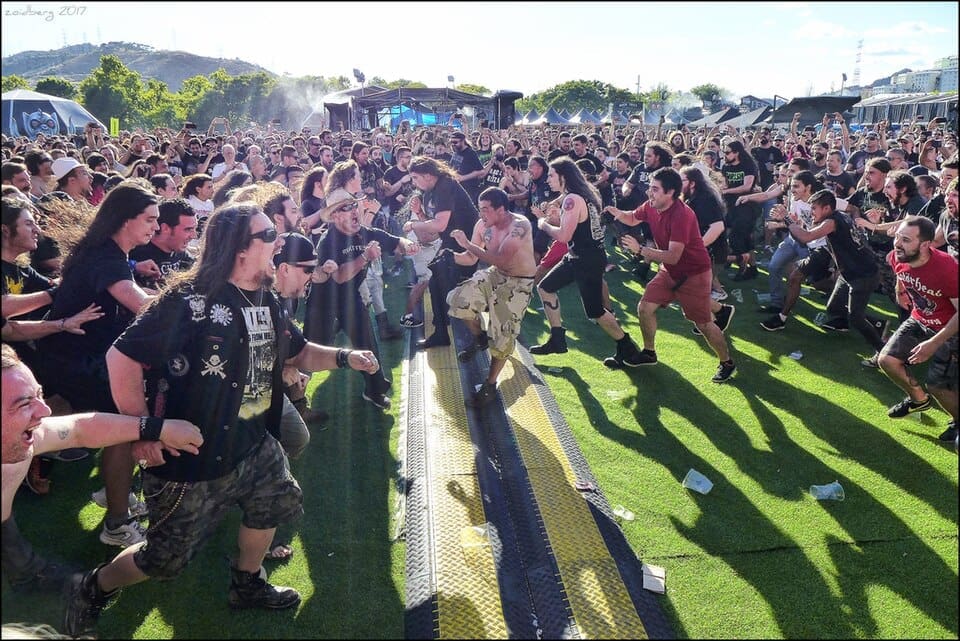
At its most extreme, moshing and crowd surges can be deeply dangerous, but moshing itself is often more performance than harm. When it emerged in the UK during the late 80s thrash metal scene, it sparked a moral panic. “If you don’t understand what’s going on, you will think the crowd members are attacking each other.” In reality, Chris explains that there’s no intention to hurt anyone, “The act of dancing and moshing is you run around with your fist flailing, but it’s totally performative.”
For security and crowd control, the term ‘Wall of Death’ means a serious threat to safety. Often initiated by artists, the large-scale mosh consists of a crowd split into two halves and charging forward. Safety concerns are reflected in the ultimate show stop contracts artists are required to sign, typically before heavy metal and hardcore gigs. “I’ve heard some contracts say that if you say the word wall of death you forfeit your whole fee for the gig.”
For signs of crowd disorder, concert-goers should look out for any sudden spikes in crowd density or surges to the barriers and work with crowd management to avoid danger. To help stay safe in disasters, it’s important to stay aware, remain upright with your arms at chest level and try to move away from barriers.
From his experience as a crowd density spotter, Chris is clear that in crowd disasters, “the victims often get cast as the villains.” In extremely serious incidents, accountability lies in the hands of ignorant artists, bad crowd management and unsafe infrastructure; however, blame often falls on the fans. “It’s a very deeply held view in society that crowds are not to be trusted, either because they’re bad, or they’re mad.”
From blame at Brighton Beach to the moral panic of mosh pits, this narrative continues to contribute to society’s distrust of crowds. Instead, ideas of panic and stampede distract from the simple failures in planning, management and infrastructure in the live events industry. Crowd disasters are rarely caused by fans alone, but often by the infrastructure that fails them. CS
Featured image via Unsplash

0 Comments